
AC Not Working After Winter? Here's What to Check First
- Update Date: July 3, 2026
Disclosure: This post contains affiliate links. If you purchase through them, we may earn a small commission at no extra cost to you.
Share the Glint Editorial Team
We're a small team of home appliance researchers and writers focused on HVAC and appliance troubleshooting across North America. Our guides are created by analyzing manufacturer manuals, HVAC service documentation, and real-world repair patterns reported by technicians and homeowners. We use multiple independent sources to validate key technical claims, including manufacturer documentation and industry safety guidelines (such as EPA and DOE references where applicable). Our goal is to turn complex technical information into clear, practical guidance for everyday homeowners.
Quick Answer: AC not working after winter is most often caused by a tripped circuit breaker, a clogged air filter, or a failed capacitor that gave out over the cold months — and all three are things you can check yourself before calling anyone. An ac compressor not working after winter specifically points to the capacitor or a locked-up compressor, both of which have clear warning signs covered in this guide. Work through the steps below in order; most homeowners find the fix in under 20 minutes.
Is this your exact problem?
AC not working after winter can look different depending on which part of the system is affected. Narrow it down with the list below — it makes the diagnostic steps much faster.
- You turned the thermostat to COOL for the first time this spring and nothing happened — no fan, no outdoor unit, no airflow at all
- The indoor fan runs and air comes through the vents, but it's room-temperature air — the outdoor unit never starts
- The outdoor unit hums for 3–5 seconds then goes silent without the fan spinning up (classic ac compressor not working after winter pattern — likely the capacitor)
- The system runs briefly, then trips the circuit breaker at the panel — and repeats every time you reset it
- Ice is forming on the refrigerant lines or the outdoor unit shortly after startup
- Everything looks normal on the thermostat but there's zero cold air — same house, same settings, totally different result than last fall
If two or more of these match, you're in the right place. Let's work through it.
What actually causes AC not working after winter — ranked by how often we see it
These aren't guesses — they're the real reasons HVAC technicians find on spring startup calls, in order of frequency. Start from the top; the first two causes alone cover more than half of all cases.
How to diagnose and fix AC not working after winter — step by step
- 1Verify thermostat settings before anything elseThis takes 30 seconds and solves the problem more often than it should. Set the mode explicitly to COOL, drop the set temperature at least 5°F below the current room temperature, and confirm the fan is on AUTO. If the display is blank or dim, swap in fresh alkaline batteries. A thermostat that reset to heating mode over winter is a surprisingly common reason for AC not working after winter — and it costs nothing to fix.
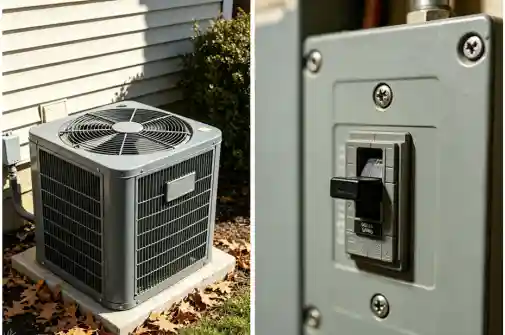
- 2Check both HVAC breakers at the electrical panelLook for breakers labeled "AC," "Air Conditioner," "Air Handler," "Condenser," or "Furnace" — there are typically two, one for the indoor unit and one for the outdoor unit. A tripped breaker sits visibly between ON and OFF. Push it fully to OFF first, then firmly to ON. If it trips again immediately when the system tries to start, stop resetting it — something is drawing excess current and a tech needs to find it. Don't keep forcing a breaker that's trying to protect the equipment.
- 3Check the outdoor disconnect boxThere's a small metal box mounted on the house wall a few feet from the outdoor unit. Open it and confirm the fuse cartridge is fully seated, the switch is in the ON position, or the breaker inside is not tripped — depending on your disconnect type. Some homeowners flip this off in fall as a precaution and forget about it completely. An open outdoor disconnect means the AC compressor not working after winter has nothing to do with the compressor at all — there's simply no power reaching it.
- 4Replace the air filter — don't just look at itPull the filter and hold it up to a light source. If light doesn't pass through the media, it's overdue regardless of the date on the frame. Install a fresh MERV 8–11 filter before running any further tests. A severely blocked filter causes the evaporator coil to freeze, which makes the whole system look broken — warm air from vents, outdoor unit cycling off, possible ice on the lines. It's a $5–$20 fix that eliminates one of the top causes of AC not working after winter before you spend a dollar on a service call.
- 5Remove the AC cover (if used) and clear visible debris by handIf a cover was placed on the outdoor unit for winter, remove it completely. Then walk around the unit and clear leaves, seed clusters, cottonwood fluff, or any debris packed against the fins by hand or with a soft brush. Check the top grille for anything blocking the fan from spinning freely. Running the system with the fins packed with debris causes the high-pressure switch to trip almost instantly — which registers as the AC not working when the actual problem is just airflow restriction.
- 6Rinse the condenser coils with a garden hoseTurn the system off at the thermostat and shut the outdoor disconnect before touching the unit. Use a garden hose at moderate pressure — not a pressure washer, which bends fins — to rinse debris from the coil. Spray from inside the unit outward if you can access the top, or from outside at a shallow angle. Let it dry 30 minutes before restarting. Clean coils are essential for heat rejection; even a partially clogged coil forces the compressor to work harder and can cause an AC compressor not working after winter situation on a unit that's mechanically fine.
- 7Listen for the capacitor failure pattern — then stop and call a proAfter completing steps 1–6, attempt a test run on a day above 65°F. Stand near the outdoor unit. If you hear a low hum for 3–5 seconds followed by complete silence — with the fan never spinning — that's a failed capacitor. It's the most common hardware reason for AC compressor not working after winter. Capacitor replacement runs $150–$400 by a tech and takes about 30 minutes; it's one of the cheapest professional HVAC repairs and absolutely worth doing on a unit under 12 years old. But the capacitor holds a dangerous charge even when power is off, so this is not a DIY job.
DIY vs. pro repair vs. replacement — what each scenario actually costs
Here's the honest picture. Most AC not working after winter situations cost nothing to resolve. The escalation path is short, but the price jumps fast once it moves past free checks.
| Fix / Scenario | DIY Cost | Pro Cost (parts + labor) | DIY Difficulty | Verdict |
|---|---|---|---|---|
| Thermostat settings fix or battery replacement | $0–$10 | $75–$150 service call if missed | 🟢 Very Easy | DIY — check this before anything else |
| Reset tripped breaker / reseat outdoor disconnect | $0 | $75–$150 service call | 🟢 Very Easy | DIY |
| Replace clogged air filter | $5–$20 | $30–$60 added to service visit | 🟢 Very Easy | DIY |
| Remove AC cover + clear and rinse condenser coils | $0–$15 | $80–$160 (part of spring tune-up) | 🟢 Easy | DIY |
| Capacitor replacement (start or run) | $15–$40 (part only — not recommended DIY) | $150–$400 installed | 🔴 High voltage hazard | Pro only — inexpensive; worth it on any unit under 12 yrs old |
| Contactor replacement (outdoor unit) | $20–$50 (part only) | $150–$350 installed | 🔴 Line-voltage wiring | Pro recommended |
| Refrigerant recharge + leak repair | Not legal without EPA 608 certification | $250–$1,500 depending on refrigerant type and leak location | 🔴 Federally regulated | Pro only — no exceptions |
| Compressor replacement | Not DIY | $1,200–$2,800 installed | 🔴 Major HVAC repair | Pro only — see repair vs. replace table before approving |
| Full AC system replacement | Not DIY | $3,500–$7,500 installed (2–3 ton central AC, 2026 average) | 🔴 Licensed tech required | Pro only — strongly consider if unit is 12+ yrs old or uses R-22 |
| ⚠ When to stop DIYing | Call a licensed HVAC technician if: the breaker trips again immediately after reset; the outdoor unit hums then goes silent (capacitor); the system runs but produces zero cooling with a clean filter and clear coils; refrigerant lines are icing up; or you smell burning near the air handler or outdoor unit. These are hardware failures — no amount of DIY will help and some carry real electrical risk. | |||
📈 Repair vs. Replace — The 50% Rule for AC Systems
New central AC systems run approximately $3,500–$7,500 installed (2–3 ton, 2026). Here's the decision framework by scenario:
|
Free checks + filter + coil cleaning Cost: $0–$50 | Any unit age | ✅ Always do this first — no debate |
|
Capacitor or contactor replacement Cost: $150–$400 | Unit age <10 yrs | ✅ Repair — low cost, problem solved |
|
Refrigerant leak repair + recharge (R-410A) Cost: $300–$900 | Unit age <10 yrs | ⚠️ Repair if under 10 years old; evaluate if older |
|
Compressor replacement Cost: $1,200–$2,800 | Unit age 8–12 yrs | ❌ Borderline — compressor often costs 35–50% of a new system; weigh carefully |
|
Any major repair on unit 12+ yrs old or using R-22 refrigerant Any cost | ❌ Replace — R-22 is phased out and extremely expensive; unit is near end of useful life |
Energy Star recommends evaluating replacement for AC units over 10 years old that are no longer keeping the home comfortable despite maintenance. Modern high-efficiency units (SEER2 16+) can cut cooling costs by 20–40% vs. older equipment. See: energystar.gov — Central Air Conditioning
Sources & References
- 🔗 U.S. Department of Energy — Maintaining Your Air Conditioner (filter impact, coil cleaning, seasonal startup guidance)
- 🔗 Energy Star — Central Air Conditioning (low ambient operating limits, replacement threshold guidance, SEER2 efficiency data)
- 🔗 RepairClinic — Air Conditioner Repair Help (capacitor failure as #1 cause of compressor not starting; contactor and refrigerant diagnosis)
- 🔗 U.S. EPA — Section 608 Refrigerant Regulations (federal certification requirement for refrigerant handling)
- 🔗 ACCA — Quality Installation Standards (outdoor unit clearance, airflow, and seasonal startup requirements)
Q1: Why is my AC not working after winter?
The most common reasons are a tripped circuit breaker, a clogged air filter, or a failed capacitor in the outdoor unit. These three causes account for roughly 70% of spring startup failures. Other possibilities include debris blocking the condenser coils, a refrigerant leak, or thermostat settings that reset over the winter.
Q2: Why is my AC compressor humming but not starting?
A humming sound from the outdoor unit for 3–5 seconds followed by silence — with the fan never spinning — is the classic sign of a failed start or run capacitor. Capacitors degrade faster in cold weather; a marginal unit in fall can fail completely by spring. Replacement by a licensed tech costs $150–$400.
Q3: How do I reset my AC breaker?
Find the breaker labeled 'AC,' 'Air Conditioner,' or 'Condenser' in your electrical panel. Push it fully to the OFF position, then firmly back to ON. If it trips again immediately, stop — there's an electrical fault that needs a professional. Do not keep resetting a repeatedly tripping breaker.
Q4: Can a dirty air filter cause my AC not to cool?
Absolutely. A severely clogged filter restricts airflow, causing the evaporator coil to freeze and the system to blow warm air or shut down. The U.S. Department of Energy identifies clogged filters as a leading cause of AC failure. Replacing a $5–$20 filter often solves the problem instantly.
Q5: What temperature is too cold to run my AC?
Most residential AC systems are not designed to operate below 60°F outdoors. At low ambient temperatures, refrigerant behavior changes and you risk damaging the compressor. Energy Star recommends testing your system only when it's at least 65°F outside.
Q6: How much does it cost to replace an AC capacitor?
Professional capacitor replacement typically costs $150–$400, including parts and labor. The part itself is inexpensive ($15–$40), but the work involves high-voltage hazards, so it must be done by a licensed HVAC technician. It's one of the cheapest common AC repairs.
Q7: Should I replace my AC if the compressor is broken?
If your unit is over 10 years old, replacement is usually better. Compressor replacement costs $1,200–$2,800 — often 35–50% of a new system. For units 12+ years old or using R-22 refrigerant, replacement is almost always recommended over repair.
Q8: How do I clean my AC condenser coils?
Turn off the system at the thermostat and shut the outdoor disconnect. Use a garden hose at moderate pressure — never a pressure washer — to rinse debris from the coils. Spray from inside outward if possible, or at a shallow angle. Let it dry 30 minutes before restarting.
Q9: Why is there ice on my AC refrigerant lines?
Ice usually indicates low refrigerant (a leak) or restricted airflow from a dirty filter or blocked coils. Turn the system off immediately and call a technician — running the system with ice can damage the compressor. This is not a DIY fix.
Q10: What does a tripped circuit breaker look like?
A tripped breaker sits in a middle position between ON and OFF, often with a slight gap or red indicator showing. To reset, push it fully to OFF, then firmly back to ON. If it won't stay in the ON position, there's an electrical issue that needs professional diagnosis.
Q11: Can a thermostat cause my AC not to work after winter?
Yes — programmable thermostats can reset to 'heat only' or 'off' mode after a winter power outage or battery change. Even with a normal display, the system won't cool. Switch the mode to COOL, set the temperature 5°F below room temp, and set the fan to AUTO.
Q12: How often should I change my AC air filter?
Most manufacturers recommend changing disposable filters every 1–3 months during cooling/heating seasons. If you have pets, allergies, or live in a dusty area, check monthly. A clean filter is essential for proper airflow and system efficiency.
Q13: What is the outdoor disconnect switch?
The outdoor disconnect is a safety switch mounted near the condenser that cuts power to the outdoor unit. Some homeowners turn it off in winter as a precaution and forget to turn it back on. If it's off, the AC compressor won't run at all — even if everything else is fine.
Q14: What is a MERV rating and which filter should I use?
MERV (Minimum Efficiency Reporting Value) measures filter effectiveness. For most residential systems, MERV 8–11 offers the best balance of filtration and airflow. Higher ratings trap more particles but can restrict airflow if your system isn't designed for them.
Q15: Why does my AC fan run but no cold air comes out?
This usually means the outdoor unit isn't running. Common causes include a tripped outdoor breaker, an open disconnect, a failed capacitor, or low refrigerant. If the indoor fan runs but the outdoor unit never starts, focus on power and capacitor issues first.
Q16: How long does an AC capacitor typically last?
Most capacitors last 5–10 years. Cold winter temperatures accelerate degradation — a capacitor that was marginal in fall may fail completely by spring. This is why capacitor failure is the #1 mechanical reason for compressors not starting at seasonal startup.
Q17: Can I replace an AC capacitor myself?
No — capacitors store a dangerous electrical charge even when the power is off. This is not a DIY job. Capacitor replacement is relatively inexpensive ($150–$400 installed) and must be performed by a licensed HVAC technician.
Q18: What is R-22 refrigerant and why does it matter?
R-22 is an older refrigerant phased out in the U.S. and Canada due to environmental regulations. It's extremely expensive to recharge and no longer produced. If your AC uses R-22 and needs repair, replacement is almost always the smarter financial decision.
Q19: How do I know if my AC needs to be replaced?
Consider replacement if your unit is over 12 years old, uses R-22 refrigerant, requires frequent repairs, or if repair costs exceed 50% of a new system's price. Modern high-efficiency units (SEER2 16+) can cut cooling costs by 20–40%.
Q20: What is a SEER2 rating?
SEER2 (Seasonal Energy Efficiency Ratio 2) measures AC efficiency under more realistic testing conditions than the older SEER standard. Higher SEER2 ratings mean better energy efficiency. Units with SEER2 16+ can significantly lower your summer cooling bills.
Q21: Why does my AC trip the breaker repeatedly?
A repeatedly tripping breaker indicates an electrical fault — possibly a short circuit, a failing compressor, a grounded wire, or an aging capacitor. Stop resetting it and call an HVAC technician. Continuing to reset it can damage equipment or create a fire hazard.
Q22: How do I find a reliable HVAC technician near me?
Look for licensed, insured technicians with positive local reviews. Check for EPA Section 608 certification (required for refrigerant handling), ACCA membership, and clear upfront pricing. Many local HVAC companies in the U.S. and Canada offer spring tune-up specials.
Q23: Should I get a spring AC tune-up every year?
Yes — an annual spring tune-up costs $80–$160 and can prevent exactly the kind of problems described here. Technicians check capacitors, clean coils, verify refrigerant levels, and ensure the system is ready for summer. It's a small investment that saves hundreds in emergency repairs.
Q24: How long does an AC system typically last?
Most central AC systems last 12–15 years with regular maintenance. Units in coastal or harsh climates may have shorter lifespans. If your system is approaching 12 years old and experiencing issues, start evaluating replacement options — especially if it uses R-22 refrigerant.
Q25: What should I do if my AC is not working after winter — summary?
Start with the free checks: verify thermostat is in COOL mode, reset both HVAC breakers, check the outdoor disconnect, replace the air filter, and clear debris from the condenser. If the unit hums but doesn't start, suspect the capacitor — call a pro. If none work, call a licensed HVAC technician.
Table of Contents
Toggle