
Why Is My Freezer Frosting Up? 5 Common Causes (+ Easy DIY Fixes)
- Update Date: August 4, 2026
Disclosure: This post contains affiliate links. If you purchase through them, we may earn a small commission at no extra cost to you.
Share the Glint Editorial Team
We're a small team of home appliance researchers and writers focused on HVAC and appliance troubleshooting across North America. Our guides are created by analyzing manufacturer manuals, HVAC service documentation, and real-world repair patterns reported by technicians and homeowners. We use multiple independent sources to validate key technical claims, including manufacturer documentation and industry safety guidelines (such as EPA and DOE references where applicable). Our goal is to turn complex technical information into clear, practical guidance for everyday homeowners.
Quick Answer: Frost in a freezer almost always means warm, humid air is getting in and freezing on the cold surfaces — caused by a bad door gasket, a door that isn't closing fully, a failed defrost system, or simply leaving the door open too long. If your freezer is frosting up on the back wall or the evaporator coils specifically, a failed defrost heater or thermostat is the likely culprit, and it's fixable for $15–$40 in parts. This guide covers every real cause of frost in a freezer — ranked by how common each is — with specific checks and fixes you can do yourself.
Is this your exact problem?
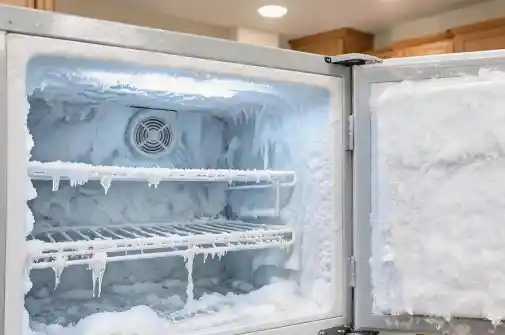
Before assuming something is broken, it helps to understand what type of frost you're seeing — because the location and pattern of frost in your freezer tells you almost exactly what's causing it. A little surface frost on food packaging is different from a solid wall of ice behind the back panel, and they have completely different fixes.
| What you're seeing | Where | Most likely cause |
|---|---|---|
| Light frost or ice crystals on food packaging | All over — especially near the door | Door opened frequently or left open too long; gasket letting in air |
| Thick frost or ice sheet on back interior wall | Rear wall of freezer compartment | Failed defrost system — frost accumulating between cycles |
| Ice forming around the door seal or door frame | Door perimeter | Cracked or compressed door gasket; warm air entering continuously |
| Frost on the evaporator coils (behind back panel) | Behind the freezer's rear interior panel | Defrost heater, thermostat, or timer failure |
| Heavy frost building up quickly after manual defrost | Anywhere — returns within 1–2 weeks | Defrost system component has failed — frost returns every cycle |
| Frost only in one corner or spot, not widespread | Corner or hinge area | Small gasket tear or gap at that specific location |
The checklist below confirms you're dealing with an actual problem worth investigating — not just condensation from a hot summer day or a newly stocked freezer.
- There is visible white frost or ice buildup inside your freezer that wasn't there a few weeks ago, and it keeps coming back
- Frost is accumulating on the back wall of the freezer, or you can feel a solid block of ice behind the rear interior panel
- Ice or frost is forming around the freezer door frame or along the gasket perimeter — a sign that warm air is entering
- You manually defrosted the freezer, it worked fine for 1–3 weeks, and then the frost in the freezer returned exactly as before
- The freezer is frosting up heavily even though the door is sealed and nobody is opening it unusually often
- Food in the freezer has ice crystals inside packaging or seems to be getting "freezer burned" faster than it used to
Why is your freezer frosting up? — causes ranked by how often we see them
Every single case of frost in a freezer comes down to one thing: humid air got in and the moisture froze. The question is how. These are the real reasons, in order of frequency.
Frost-free freezers automatically run a defrost cycle every 8–12 hours, using a heating element to melt any frost that built up on the evaporator coils. When this system fails — whether it's the defrost heater burning out, the defrost thermostat failing to trigger the heater, or the defrost timer/control board skipping the cycle — frost accumulates unchecked with every refrigeration cycle. What starts as a thin layer on the back wall becomes, over weeks, a solid block of ice that covers the entire evaporator coil assembly.
This is the classic case of why a freezer is frosting up heavily even though the door seals perfectly and nobody is doing anything wrong. The frost returns on a predictable schedule — usually within 1–3 weeks of a manual defrost — because the root cause is never addressed. RepairClinic identifies defrost system failure as the leading cause of excessive frost buildup in frost-free freezers.
The door gasket is the rubber seal around the entire freezer door opening. When it cracks, tears, stiffens, or gets pushed out of its channel, warm humid room air enters the freezer continuously — every hour, all day. That air hits the cold interior surfaces and the moisture freezes. The result is frost in your freezer that isn't limited to one spot — it tends to appear near the door frame first, then spreads as ice builds up.
Gaskets degrade with age and from repeated opening, especially if food residue has built up in the seal channel (which prevents the gasket from pressing flat against the door frame). A gasket issue is also why a freezer is frosting up specifically around the door perimeter or in one corner near a hinge.
Every time you open the freezer, warm room air rushes in. In a busy household — or if the door isn't pushed closed completely and sits slightly ajar for hours — the cumulative moisture load exceeds what the defrost system can handle, and frost accumulates faster than it can be melted away. This tends to produce light, powdery frost on food packaging and near the door, rather than the dense back-wall ice of a defrost failure.
Chest freezers are especially prone to this when the gasket ages, because the lid relies entirely on gravity and gasket compression to seal. Upright freezers can also develop a habit of not quite latching if a drawer or shelf is slightly misaligned.
Placing warm leftovers or hot food directly into the freezer introduces a burst of steam and humid air every time. That moisture immediately condenses and freezes on the nearest cold surface — usually the back wall or the food itself. Done repeatedly, it contributes meaningfully to frost buildup even in a perfectly functioning freezer. The USDA recommends cooling food to room temperature before freezing for both food safety and appliance performance reasons.
In hot, humid climates — or in a kitchen or garage that gets very humid in summer — the moisture load in the air is simply higher than in a dry environment. Every door opening brings in more moisture per cubic foot of air than it would in a drier climate. If your freezer is frosting up consistently in summer but barely at all in winter, ambient humidity is contributing. This isn't a broken appliance — but it does mean you should check the door gasket more frequently and consider whether the freezer's defrost cycle frequency is adequate for your conditions.
How to diagnose and fix frost buildup in your freezer — step by step
- 1Test the door gasket with the dollar-bill methodClose the freezer door on a dollar bill or piece of paper at multiple points around the entire door perimeter — top, sides, bottom, and all four corners. Pull each one out. If it slides free without resistance at any point, the gasket is not sealing at that location. Also visually inspect the full gasket for cracks, stiffness, or sections where the rubber has been pushed out of its channel. Clean the gasket with warm soapy water — sometimes a sticky residue prevents the seal from sitting flat. If the gasket is cracked or torn, order a replacement by model number on PartSelect ($20–$60 for most models, press-in installation, no tools).
- 2Check that the freezer door closes and latches fullyOpen the freezer door to 90 degrees and let go. A properly balanced door on a leveled appliance should swing gently toward closed, not stay open or drift further open. If the door stays open or swings away, the refrigerator needs leveling — adjust the front leveling feet so the unit tilts very slightly backward (about ¼ inch lower at the back). Also check that no drawer, shelf, or food item is preventing full door closure. And make sure the door wasn't recently reattached or had its hinges adjusted — a misaligned door won't seal properly even with a perfect gasket.
- 3Perform a manual defrost and watch for recurrenceUnplug the freezer. Remove all food to a cooler with ice. Leave the freezer doors open for 24–48 hours with towels on the floor to catch meltwater. Do not use sharp objects to chip ice — this damages the evaporator coils. A hair dryer on low heat, kept moving and at least 6 inches from surfaces, speeds the process. Once fully defrosted, dry the interior and plug the unit back in. This is both a fix and a diagnostic: if frost in your freezer returns in the same location within 1–3 weeks, the defrost system has failed and needs repair. If it doesn't return, the cause was probably usage-related (frequent opening, warm food) and you've solved it for now.
- 4Access the evaporator and test the defrost componentsUnplug the freezer. Remove all food and the rear interior panel inside the freezer — typically 2–6 screws depending on your model (check ManualsLib for your exact model's disassembly diagram). You'll see the evaporator coils and the defrost heater element (a glass or metal tube woven through or near the coils), along with the defrost thermostat (a small clip-on sensor) and possibly a defrost timer. With a multimeter set to continuity, test the defrost heater: disconnect its two leads and check for continuity. No continuity = heater has burned out and needs replacing ($15–$40 on PartSelect). Test the defrost thermostat the same way — no continuity when cold = failed thermostat ($10–$25).
- 5Replace the failed defrost componentOrder the correct replacement part from PartSelect using your model number — this ensures you get the exact heater, thermostat, or timer that fits your unit. Defrost heaters typically have two wire connectors and are secured by a clip or bracket near the evaporator coil. Defrost thermostats clip onto the coil with a single mounting clip. Follow the disassembly in reverse, reconnect all wires, reinstall the rear panel, and plug the unit back in. Give it 24 hours to reach operating temperature before restocking. If frost in your freezer doesn't return after 2–3 weeks, the repair was successful.
- 6When to stop and call a technicianStop and call a licensed appliance technician if: the defrost heater and thermostat both test fine but frost keeps returning; the main control board (which triggers defrost cycles on modern fridges) is suspected to have failed; or the evaporator coils are cracked or visibly damaged. Control board diagnosis requires specific test equipment and model knowledge. And if the evaporator is physically damaged from aggressive ice chipping, refrigerant may have escaped — that requires an EPA 608 certified technician to repair. Tell the tech exactly what you've already tested — it saves time and reduces your diagnostic bill.
DIY fix vs. pro repair vs. replacement — the real cost breakdown
Most freezer frosting problems are cheap to fix. The defrost system parts are inexpensive and accessible. Here's where the costs land, from free behavioral fixes to the one situation where replacement makes more sense than repair.
| Fix / Scenario | DIY Cost | Pro Cost (parts + labor) | DIY Level | Verdict |
|---|---|---|---|---|
| Manual defrost (temporary fix + diagnostic) | $0 — time and towels | $100–$200 service visit | 🟢 Very Easy | DIY — always do this first |
| Clean door gasket + behavioral changes (usage habits) | $0 | N/A | 🟢 Very Easy | DIY — free fix, try before anything else |
| Replace door gasket | $20–$60 (model-specific part) | $100–$220 installed | 🟢 Easy — press-in channel, no tools needed | DIY |
| Replace defrost heater element | $15–$40 (part) | $150–$300 installed | 🟡 Moderate — rear panel removal, multimeter test | DIY if comfortable with basic appliance disassembly |
| Replace defrost thermostat | $10–$25 (part) | $120–$250 installed | 🟡 Moderate — same access as heater | DIY — inexpensive part, straightforward swap |
| Replace defrost timer (on older mechanical timer models) | $15–$35 (part) | $120–$250 installed | 🟡 Moderate | DIY once part is confirmed with model number on PartSelect |
| Replace main control board (modern models) | $80–$200 (part) | $250–$500 installed | 🔴 Requires diagnosis to confirm | Pro recommended for diagnosis; DIY swap if confirmed by tech |
| Evaporator coil repair / refrigerant leak (if coil was damaged) | Not legal without EPA 608 certification | $300–$800+ | 🔴 Licensed tech required | Pro only — see replacement calculator below |
| ⚠ When to stop DIYing | Stop and call a licensed appliance technician if: defrost heater and thermostat both test good but frost keeps returning (control board likely); the evaporator coils appear cracked or have oily residue (refrigerant leak); or the unit is under manufacturer warranty (DIY repair may void it). Never chip ice aggressively from the coils — puncturing the coil causes refrigerant loss and turns a $25 part repair into an $800 service call. | |||
📈 Repair vs. Replace — Is This Freezer Worth Fixing?
A new standalone freezer costs $200–$600 (chest or upright, 2026). A new refrigerator-freezer combo runs $800–$1,800. Energy Star certified models save $30–$100 per year on operating costs versus older inefficient units. Use this table:
|
Gasket, defrost heater, thermostat, or timer Cost: $10–$60 DIY | Any appliance age | ✅ Repair — always worth it, very low cost |
|
Gasket or defrost components via pro repair Cost: $120–$300 pro | Appliance age <8 yrs | ✅ Repair — well under 50% of replacement cost |
|
Control board replacement Cost: $250–$500 pro | Appliance age <7 yrs | ⚠️ Evaluate — repair if under 7 years old; consider replacing on older units |
|
Refrigerant leak / evaporator coil repair Cost: $300–$800+ pro | Any age | ❌ Usually replace — repair cost approaches or exceeds 50% of a new unit on any appliance under $1,200 |
|
Any repair on a freezer 12+ years old Any cost | ❌ Strongly consider replacing — average freezer lifespan is 12–20 years; an Energy Star model saves meaningfully on electricity over the next decade |
Energy Star certified freezers use at least 10% less energy than the federal minimum standard. See: energystar.gov — Freezers
Sources & References
- 🔗 RepairClinic — Frost or Ice in Freezer Repair Help (defrost system failure as leading cause of frost in freezer; component diagnosis by symptom)
- 🔗 PartSelect — Frost or Ice in Freezer Repair Guide (defrost heater, thermostat, timer, and gasket part lookup by model)
- 🔗 U.S. Department of Energy — Refrigerators and Freezers (maintenance guidance, door seal importance, operating efficiency)
- 🔗 Energy Star — Freezers (efficiency standards, certified model guidance, replacement cost justification)
- 🔗 USDA FSIS — Freezing and Food Safety (recommendation to cool food before freezing; food safety and frost formation)
- 🔗 ManualsLib — Refrigerator and Freezer Manuals (evaporator panel disassembly, defrost component location by model)
Q1: Why is my freezer frosting up?
A freezer frosting up is almost always caused by warm, humid air entering the freezer. The most common reasons include a damaged door gasket, a door left slightly open, a failed defrost system, or frequent door openings. The frost pattern usually reveals which problem is responsible.
Q2: Why is there frost in my freezer?
Frost forms when moisture in warm air enters the freezer and freezes on cold surfaces. A small amount of frost after frequent door openings can be normal, but heavy or recurring frost usually indicates a sealing or defrost system problem.
Q3: Is frost in a freezer normal?
A light layer of frost on food packaging or after frequent use is normal. Thick frost on the back wall, around the door, or covering shelves is not normal and should be investigated.
Q4: Why is my frost-free freezer frosting up?
A frost-free freezer frosting up usually means the automatic defrost system has failed. The defrost heater, thermostat, timer, or electronic control board may no longer be melting frost during scheduled defrost cycles.
Q5: Why is my freezer frosting up on the back wall?
Heavy frost on the back wall is one of the strongest signs of a failed defrost system. Ice accumulates behind the rear panel because frost is no longer being melted during normal operation.
Q6: Why is frost building up around my freezer door?
Frost around the freezer door usually indicates warm air leaking through a damaged, dirty, or misaligned door gasket. Even a small gap allows moisture to enter continuously.
Q7: Can a bad door gasket cause frost in the freezer?
Yes. A worn or torn door gasket is one of the most common causes of freezer frost buildup because it allows humid room air to enter every time the compressor runs.
Q8: How do I know if my freezer door gasket is bad?
Perform the dollar-bill test by closing the door on a dollar bill. If it pulls out easily without resistance, the gasket may no longer be sealing properly.
Q9: Can opening the freezer too often cause frost buildup?
Yes. Every time the freezer door opens, warm humid air enters. Frequent door openings can create light frost on food packages and interior surfaces, especially during humid weather.
Q10: Why is my freezer frosting up after I manually defrosted it?
If frost returns within one to three weeks after manual defrosting, the underlying problem—usually a failed defrost heater, thermostat, or door gasket—has not been repaired.
Q11: Why does frost keep coming back in my freezer?
Recurring frost usually means moisture continues entering the freezer or the automatic defrost system is no longer working correctly. Manual defrost removes ice temporarily but does not fix the root cause.
Q12: Can putting hot food in the freezer cause frost?
Yes. Warm food releases steam that quickly freezes on cold surfaces, contributing to frost buildup inside the freezer.
Q13: Does high humidity make my freezer frost up?
Yes. During humid summer months, each door opening allows significantly more moisture into the freezer, increasing frost accumulation even when the appliance is working normally.
Q14: Why is there frost on my frozen food?
Ice crystals on frozen food usually develop when warm air enters the freezer repeatedly or food is stored for long periods. Packaging that is not airtight can also contribute to freezer burn.
Q15: How do I remove frost buildup from my freezer?
The safest method is to unplug the freezer, remove the food, allow the ice to melt naturally, and wipe away excess water. Avoid using sharp tools that could damage the evaporator coils.
Q16: Can I use a hair dryer to remove freezer frost?
Yes, but only on a low heat setting while keeping the dryer moving continuously. Never concentrate heat in one area or allow electrical components to become wet.
Q17: How long should it take to defrost a freezer?
Depending on the amount of ice, a complete manual defrost usually takes between 24 and 48 hours if allowed to melt naturally.
Q18: Why is my freezer frosting up even though the door is closed?
If the door is fully closed but frost continues to form, the automatic defrost system or door gasket is the most likely cause rather than user habits.
Q19: Can a failed defrost heater cause frost buildup?
Yes. A failed defrost heater cannot melt frost from the evaporator coils, allowing thick ice to build up behind the rear freezer panel over time.
Q20: How much does it cost to fix a freezer frosting up?
Many freezer frosting problems are inexpensive to repair. Replacing a gasket or defrost heater often costs much less than replacing the appliance, while electronic control board repairs are more expensive.
Q21: Can I repair a freezer frosting problem myself?
Yes. Homeowners can often replace door gaskets, manually defrost the freezer, or replace a defrost heater if they are comfortable removing the rear freezer panel. Electrical diagnosis may require a professional.
Q22: When should I call a freezer repair technician?
Call a qualified appliance repair technician if frost returns after replacing the gasket or defrost components, or if you suspect a failed control board or refrigerant-related problem.
Q23: Should I repair or replace a freezer with heavy frost buildup?
Repair is usually worthwhile for gasket or defrost component failures because the parts are inexpensive. Older freezers with multiple major repairs may be better candidates for replacement.
Q24: How can I prevent frost buildup in my freezer?
Keep the door gasket clean, minimize door openings, allow hot food to cool before freezing, and inspect the freezer seal regularly. These simple habits greatly reduce moisture entering the freezer.
Q25: Do I need freezer repair service near me if my freezer keeps frosting up?
If frost continues to return after manual defrosting and basic troubleshooting, a local appliance repair technician can diagnose failed defrost components, control board issues, or sealing problems before cooling performance declines.
Table of Contents
Toggle